Flickr Badge

Showing posts with label startup. Show all posts

Sunday, July 22, 2012

Why did VCs/angels miss investing into Interview Street at an early stage?

Recently Y Combinator selected TapToLearn and Plivio into their program. This is after they selected Interview Street in an earlier batch.

I don't know TopToLearn and Plivio personally, but Vivek from Interview Street was pretty active in the Chennai startup scene for a long time before moving to Bangalore and finally into YC.

He bootstrapped for many years while pivoting on several themes. Apart from Morpheus, who bought into his idea, why didn't any other Indian investor buy into it?

I'm sure a lot of VCs and angel networks would be kicking themselves now. They had a chance to invest early into a global startup that is now going places, and they missed the chance. Instead they will invest millions into the next shaky e-commerce, travel or deal site.

It's embarrassing when they have these companies growing right under their noses, and it takes YC to recognise them.

Monday, January 09, 2012

Minimum Viable Product & the Tour My App roadmap

Recently there has been a lot of noise made about minimum viable products (MVP). MVP was the topic at this month's Chennai Open Coffee Club. Unfortunately I couldn't make it at the last minute, so there are my thoughts on MVP and our approach to building Tour My App.

We recently launched a new product called Tour My App. This is a product through which you can create "tours" to guide users step by step through the actions required to complete tasks in your web application. In this post I'll explain how we are applying the MVP concept in Tour My App.

First some history.

We've always wanted a tour functionality in our other product - Tools For Agile. We searched for various solutions, but didn't find anything that fit our needs. In the meantime, The Startup Center had an event called In 50 Hours. The premise of the event is simple - build a product from scratch in 50 hours. Kausikram went ahead and built an initial prototype of Tour My App over the weekend. The idea was to later on incorporate that into our product. However, during the demo at In 50 Hours, many people expressed interest in having that functionality in their products as well. We then decided to split this functionality into a separate product.

Tour My App was born.

Having decided to build it out into a separate product, we now needed to figure out our release plan. Here is where the MVP concept enters the picture. MVP is a principle to build just enough of the product to validate your assumptions. They may be assumptions on user adoption, pricing model, sales model, technology... anything relating to the product. We have some idea about all these factors when we start, but they are all assumptions. How do we validate it? What we do not want to do is to build a big product and then learn that many of our assumptions are wrong. So, our goal was to build the product piece by piece in order to answer the most important questions up front.

Out of all the questions, the top questions right now were
  1. Is Tour My App solving a real problem?
  2. Will people pay to have this problem solved?
The idea for Tour My App comes directly from a problem we faced ourselves. We badly wanted this functionality in Tools For Agile. Our analytics showed that many users signed up for Tools For Agile but would leave before they performed a single action. If we could get users started easily, then we could make our users much more productive - and increase the chance they would become heavy users.We were ready to spend money to get this solved, but we couldn't find any other product that we could use. We were desperate to get a solution. That is why after a few months of looking, Kausik decided to just write it himself.

But this is just one data point. Were there other companies like this? And would they pay to have it solved?

These were the questions we wanted to answer.

So we did something unconventional - we charged for the beta. 

Generally beta testers get the product free. So why did we charge for it? In usual terminology, beta testers are testers. This means that they are given a buggy product and are expected to report bugs. In exchange for this service, they get the product free. In our case, the product is not buggy. We even have a demo page showing it in action. We want people, not to test the product, but to solve their problems.

The initial beta pool is a set of companies who really have a serious problem, are willing to pay to get the problem solved and the problem is serious enough that they want to explore solutions right now, rather than wait for the application to go live later.

In other words, we want to filter out the people who signed up for beta expecting a free toy to play with, and focus on those who need Tour My App.

So what does all this have to do with MVP? And if the product is production quality, then why are we in beta?  Simple, the quality is at production level, but the product isn't finished.

You see we only built the bare minimum functionality to run a tour. There is still no UI, no sign up page, no login page. In order to save a tour, we have to go into the database and create user accounts and store the data manually.

Why did we do this? Because building those features now doesn't help us answer the questions we want answered at this point. The MVP is the minimum you need to build to get answers to your questions. So we cut out these features for now. We'll build it later.

We are sitting down with the beta companies, and together figuring out what different kinds of tours they need. Based on that we will add the data to run the tour into the database and the tour can then be deployed live into the app.

The discussions will also highlight whether we need to add more functionality into Tour My App or not. We have thousands of potential features in our minds. We are not going to implement any of them until we come across a beta customer that needs it. Then we will build it. So we are not building features based on assumptions, or coolness, but only when see a need in front of our face.

In this phase we want to answer the question: Can we build the kinds of tours that customers need?

Once we figure out the answer to that question, and are satisfied that we are doing a good job of solving beta customer problems, only then will we build out the frontend, the website, the signup page, login page and all that. All that is simple - there is no unknown risk there.

Then we will open to the public with the live application.

PS: Do you think you are losing customers (and therefore, lots of revenue) because some proportion of users cannot figure out the steps required to complete tasks in your web application? Is the problem so bad that you want a solution right now and are willing to pay to have it solved? Then give us your email and we'll bring you into the beta program.

Thursday, March 17, 2011

Why your startup should not start with a Freemium biz model

I'm reading Ash Maurya's book Running Lean that I picked up from AppSumo's Lean Startup bundle [The bundle gives you $6000 worth of ebooks and web app subscriptions for only $99. Its a total bargain, but only 3 days to go before the offer expires, so get it soon - use this link and I'll get a $10 credit :)].

There is a section on the freemium pricing model and why startups should not start with freemium. This part really resonated with me because we fell into many of these problems early on. The reasons against freemium are:
  • Low or no conversions: Startups often give away too much in the free plan, leaving users with no need to upgrade
  • Long validation cycle: Conversion rates on upgrades are low, so its hard to validate the pricing model
  • Focusing on the wrong metric: Causes a premature shift in focus from building the right product for paying customers to new user sign up
  • Low signal to noise ratio: Free users may give feedback that paying users dont care about
  • Free user's aren't free: It costs time and money to support free users
Do you think freemium works? What are your thoughts?

This post is a part of the selected archive.

Tuesday, January 18, 2011

Why New Ideas Can Be Bad

This is a great post from Tim Kastelle: Why New Ideas Can Be Bad which ties in with my blog post from last year: Too many people are ideating, not enough are executing.

Tim references a talk by Scott Belsky at the 99% conference. Here is what Belsky says:
When ideas are new, we have lots of excitement and energy. However, once we settle into trying to make the idea real, the levels of both excitement and energy go down – it starts to feel more like work. How do we respond to this?

According to Belsky, the natural response is to look for the excitement of a new idea again – and succumbing to this temptation is deadly.

Read the whole thing.

This post is a part of the selected archive.

Tuesday, December 21, 2010

Sales Stories

This post is the first in a series of stories on selling.

This stories in this post are from the book Hope is not a strategy.

On targeting the pain point
Early in my sales career as an account manager, I was in the back of the room while one of my product specialists was presenting a system. We were extremely proud of the functionality and about halfway through the presentation, our product rep put up a slide and said, "Now, if you were a hospital, you'd really like this feature."

What!? I was utterly stunned. I thought to myself, "They're not a hospital-they're a bank! They're never going to be a hospital; they'll always be a bank!"

How preposterous, the idea of showing a hospital feature to a bank.

But this is no less preposterous than showing somebody a solution to a problem they don't have-or a feature for which they have no need. You might as well show a hospital feature to a bank.

On trust
The evaluation process was grueling. Two vendors were pitted against each other and were required to do detailed benchmark implementations in the evaluation of their products. It was an exhausting, detailed process with perhaps twelve to twenty people on each vendor's side.

In the end, we won by a couple of points, but we broadened that advantage into a business partnership. Their executives met our chairman. We had a corporate visit. We continued to talk about implementation and support and widened the gap. We actually reached a measure of business partnership before they signed the contract.

At dinner the night before the contract signing for multiple financial systems, the client said, "Oh by the way, do you have a fixed asset system?"

"Certainly"

"How much is it?"

"Seventy-five thousand dollars."

"Add it to the proposal."

I thought, "They just bought a system sight unseen. How could they have required such detailed evaluation in the beginning and now they have bought a system they never even looked at?"

But they went further.

They added the graphic user interface for all the systems, which they knew was in the prototype phase. There were no references for this three-hundred-thousand-dollar product at that time. The opportunity went from six hundred thousand dollars to almost a million dollars, and forty percent of it was on products they had never seen.

How could they evaluate in the beginning in such detail and buy products sight-unseen now?

The answer is trust. They trusted our products based on the ones they had evaluated. If those worked, then these must. They trusted us as a company because they had met our top executives, they'd been to our headquarters, and they knew we were a stable industry leader with a good track record of delivery. And they trusted us personally because we understood their business and we had become friends
Got more stories that you would like to share? Add it in the comments below.

This post is a part of the selected archive.

Wednesday, November 24, 2010

Really disappointed with TiE Entrepreneur Awards

I attended TiECon Chennai today. This is the big annual event organized by TiE Chennai for the entrepreneur community here. I'll put down my detailed experience notes elsewhere, in this post I want to talk about the TiE Chennai Entrepreneur of the Year awards.

TiE gives these awards to entrepreneurs every year in a variety of categories - social entrepreneur, start up, family entrepreneur and so on.

This time I had a chance to check out the award winners for the last three years, and to say I was completely disappointed is an understatement.

The entrepreneur awards were all given to huge, well established companies. Most of these people had been running their companies for 15 years or more. Some over 25 years. I can understand giving them an award when they were in the startup phase, but 20 years after they established their company? And we are talking companies that have hundreds of crores in revenue. Many of these are publicly listed companies. See the previous award winners here.

How the heck can you call these startups? Why is TiE giving Entrepreneur of the Year awards to them? Will we see Narayana Murthy and Mukesh Ambani being awarded next year?

There is no way that entrepreneurs in the audience are going to relate to these companies. Far from being an inspiration, it is extremely deflating that a forward thinking organization like TiE chose to ignore actual startups and instead promote the big, well established names :(

Monday, October 04, 2010

3 Oct OCC Meetup Roundup

We had the October 2010 meetup of the Chennai OCC. Tony Aug, VP IT of Sanmina had come down to attend the meet. Once of the big problems startups often have is understanding how large enterprises make decisions. This is really important in the context of B2B enterprise sales. So it was really good to have Tony come down and talk about the executive perspective when purchasing software.

Some points from the meetup -
  • The #1 reason for purchase in a recessionary environment right now is to cut costs. If you can show substantial cost reductions, then that is a big win.
  • Many cloud/SaaS startups dont understand the security and privacy needs of enterprises. Eg: A company like Sanmina with operations in 20 countries need to run only on certified infrastructure that comply to EU security and privacy regulations, HIPAA, and a host of other regulations. Startups right now cannot guarantee all this
  • Pricing: $10/user a month sounds reasonable, but multiply it by 50,000 users and it becomes huge. So you will need to find a way to get it into the team on one pricing model and then switch to another pricing model (possibly a flat price) when rolling out to the whole organization
  • Dont forget about switching costs. Once an organization has spent tons of money on training and integration, it is unlikely that they will switch over, even to a superior product, unless there is a really easy path for them to do so
  • Subscription pricing is great because it allows organizations to get started without expensive capital expenditure. The old model was to buy expensive servers, install expensive software, training, integration and then you could look to get RoI. The new model is to subscribe and cancel if it doesn't work out
  • You can expect a small team to pay by credit card, but larger orders will need a purchase order and go via the purchasing department. Once that happens a lot of other stakeholders will look at it and question the need for the purchase. So you will have to answer to these other stakeholders too.
  • Lock-in is important in a subscription service. Most companies will want to be sure that they can get their data out at any time
  • Sanmina is a huge believer in open source - cuts costs and there is a community to help. For mission critical systems they pay for commercial support
  • Escrow: Larger companies will usually ask startups that the source code be put in escrow. In case the startup closes down, the company gets access to the source.
  • Using tools like Linkedin, it is really easy nowadays to find a path to get to a decision maker in any company

Wednesday, September 22, 2010

The difference between a conference and an unconference

One of the things I really like about unconferences is that there is very little "gyan" and a lot of experience sharing. This came home to me when participating in a session on hiring.

The question was: "What strategies do you follow for hiring and building a team?"

This same topic was discussed in a panel in the NASSCOM Product Conclave last year, with some VCs on the panel. In typical panel style, a lot of gyan was thrown around: "Hire only the best people", "Top people create top teams" etc.

That's stating the obvious. I mean which startup doesn't want to hire the best people? Do these VCs believe startups are intentionally hiring poor people because they believe its a better strategy??

The fact is that there are a lot of on the ground challenges to hiring that these panelists are hand waving away with their gyan:
  1. Startups are always short of cash and cannot match the compensation in bigger companies
  2. A lot of startups hire good guys only for them to leave in 6-12 months
  3. Really good guys are hard to find
  4. Most employees are not interested in stock options (a lot of Silicon Valley returned VCs talk about stock options... one wonders if they have actually recruited in India)
At the end of the panel, the audience is usually unsatisfied. The panelists tell them what they already know without a word on tackling ground level challenges that they face.

Now compare that with an unconference. Once more this topic came up at the TiE unconference.

Look at the answers this time:
  1. Many top people are around in smaller cities, who are not taken by big companies because of a lack of english skills. They are smart and make good startup employees
  2. Find a few people who believe in your vision and then complement them with freshers
  3. Look at 6 month internships - lots of smart people available as interns
  4. Look at your requirements - not all types of work require the best people. Some types of work are repetetive and may just make good employees bored.
  5. Look at the attitude and teach the skills
These are strategies that are coming from the experience of people who actually have to tackle these on-the-ground problems. At the end, the participants feel charged up with ideas to take back and implement the next day.

This is really what makes an unconference different for me. The focus on real solutions to real problems is invaluable.

Friday, September 10, 2010

Twelve Reasons Why Businesses Fail

From Naeem Zafar's book Seven Steps to a Successful Startup:
  1. Solving a problem that most users are not willing to pay to solve your way
  2. Thinking that you can do it all by yourself
  3. Lacking trust among team members
  4. Being overconfident and not questioning yourself
  5. Lacking a crisp, singular focus&emdash;Trying to be everything to everyone
  6. Marketing myopia
  7. Confusing a hobby with a business
  8. Pricing incorrectly and not knowing your real competition
  9. Failing to properly define your market and customers
  10. Not having enough financial resources available
  11. Focusing on a market segment too small to sustain you
  12. Starting a business for the wrong personal reasons
This post is a part of the selected archive. 

Tuesday, August 17, 2010

Dont forget to validate your assumptions

There is just so much you can learn from customers (or potential customers) that you should spend at least one day a week talking to them. You'll be amazed at what you can learn.

Technical founders especially love dreaming up cool stuff and getting to coding.

This is a huge mistake.

I recently spoke to one of our customers and asked them what their favourite feature was. I was stunned when they mentioned that sending email when a comment was added was a killer feature for them.

The shock was because we always thought this feature as a commodity feature. I mean, every tool out there has the ability to send email when a comment is added. We had a whole lot of really killer features, but this was one of the key features??

So I probed further.

Turns out that other tools only send out emails for discussions that you are involved in. Our tool sends out emails for everything. Think of a mailing list - you get every email whether you participated or not. Whereas a forum only sends you notification for new replies in the threads where you participated. It was something like that.

We always thought sending email for everything was a limitation. It was on our roadmap to refine it and make it send email selectively.

Well, guess what? Rather than being a limitation, it was actually a feature! And a killer feature for them.

So I called another customer - and this was an important differentiating feature for them too!

In a startup, we make a ton of assumptions. Don't forget to get them validated. Usually what the customer thinks is important is not what you assumed it would be.

Sunday, May 30, 2010

Too many people are ideating, not enough are executing

Here is a pet peeve of mine that is strong enough to actually wake up this blog from hibernation.

I've been seeing this "ideating" word being tossed around as the new cool thing. Every event now seems to have an ideation workshop or innovation workshop. We've been doing innovation jams at Proto.in for ages now. This weekend we had an IdeaCamp event here in Chennai.

These days even organizations like Nasscom and CII are jumping on the ideation bandwagon.

The premise is simple: get a bunch of people together, bounce ideas off the crowd and make it better.

As an entrepreneur, I find these sessions seriously turning off. I used to be excited about them, but not anymore.

Invariably no one brings up the hard questions: Whats the market for this idea? How will you price it? Are there any competitors? How much will it cost to build? How will you fund it?

And finally, when the event is over everyone forgets the idea and gets back to normal work.

Count up all the ideas from all the innovation jams, ideation sessions, BarCamps, IdeaCamps over the last four years... then count out how many have been executed on. My guess is zero.

The ideas are basically dead on arrival.

So why do we have so many ideation sessions?

Its fun. Its collaborative. And everyone likes to escape from the present and imagine the future. Execution is hard, and execution is definitely not-fun. Ideation is instantaneous, and best of all free! I feel sorry for execution - its hard, long, time consuming, and expensive :(

But lets face it: ideas are a dime a dozen. Execution is what counts.

Everyone remembers Edison's quote: Genius is 1% inspiration, 99% perspiration.

So, how about we stop ideating and start executing?

Thursday, January 14, 2010

Sunday, March 15, 2009

10 Trends in ICT: My Talk At VIT Entrepreneurship Awareness Camp

Here are the slides from my talk at VIT yesterday. The slides may not make much sense without the actual talk though.

Thursday, December 25, 2008

Proto.in Registrations Open

Registrations for the fifth edition of Proto.in are open! You can register here - http://proto.in/register/

Proto.in is an event that aims to bring together startups, investors and industry people in one location. Its a two day event. The first day will have a number of talks on startups. Usually these cover topics like funding, business plans, bootstrapping and so on. There are also technology talks. The second day has some selected startups presenting their product followed by an open house where you can interact with startups and investors.

This event is the fifth edition of Proto.in. The first three editions were in Chennai, the fourth in Delhi. This edition is going to be held in Bangalore, so its pretty convenient for people from Chennai to attend.

Find out more about Proto.in here - http://proto.in/

The cost of registrations is Rs.750 for one person or Rs.1000 for two.

Again, this is the URL - http://proto.in/register/

Saturday, July 19, 2008

Chennai OpenCoffee Club Turns One!

It's hard to believe but the Chennai OpenCoffee Club will soon turn 1 year old. Vaidhy and I started it with the first meetup on the 5th of August, 2007 at Subway (Read about it here). Since then, OCC has spread out to Bangalore, Mumbai, Pune, Hyderabad, Delhi, Noida and Kolkata (See the links at the bottom of this post to join these OCC groups).

What is the Chennai OpenCoffee Club?

Here's the blurb from the website
The Chennai OpenCoffee Club is a place for people involved in the startup ecosystem to meet in an informal setting. Anyone involved with startups - entrepreneurs, developers, lawyers, investors - is invited to come and join the conversation.

Chennai OpenCoffee Club Links

Media Coverage
OpenCoffee Clubs In Other Cities

If you are from another city or traveling, you might want to catch up with one of these other OpenCoffee Clubs

Monday, April 21, 2008

Monday, March 31, 2008

Roundup of Barcamp Mumbai 3

Vijay and I were in Mumbai on Saturday for Barcamp Mumbai 3. I had checked the wiki the day before and there were over 600 registrations. Wow. Out of that I guess about 200-220 turned up, which is still a pretty big crowd.

There was some confusion at the start especially with the schedule board with a big crowd putting up sessions only for everything to be rearranged by track so that all startup demos go into one room and so on. Eventually by the time everything started we were running about 90 minutes late. The other problem was the wifi. I asked about five of the volunteers, but no one seemed to know the settings. I finally got the wifi configured thanks to one of the students sitting next to me.

I first headed out to the startup demo track and checked out demos of on2biz, MediaMelon and WikiSlice. on2biz is a workflow management web app. From the demo, it looked like it is targeted towards the sales cycle. MediaMelon is a video delivery network that uses p2p to deliver the videos. I would have loved to have seen a demo, but apparently the firewall was blocking the app. WikiSlice is a UI layer around wikipedia that allows you to browse topics better (grouping related pages, subtopics etc). They have also made it work with an offline wikipedia dump. My initial reaction was why anyone would want wikipedia offline, but the discussion brought up some interesting cases like rural access.

I headed out for the Firetalk track, but it seemed to have fizzled out, nothing was happening there. I went to the tech track. A talk on jQuery was going on but both the wifi and the projector were not working in this room. The laptop was connected to a computer monitor making the slides unreadable, and the lack of wifi meant that the online demos didnt work.

The next talk was on Asynchronous IO by Bhavin. This was a really good talk, and fortunately it didn't depend so much on the slides. A couple of points - having worked with async IO, it really complicates the application logic, especially state management, so thats a tradeoff that must be made. The other problem with not handling each request in its own process is that if there are any misbehaving callbacks, they can bring down the whole server. A pretty interesting talk.

Next was my session on some of the homebrew stuff that people have done on the Nintendo DS, following which was a session on Facebook API, except the speaker didn't show up, so I left the room. I spent the rest of the day floating between rooms and the lobby area.

I managed to catch bits of Aalaap's demo of linkbunch, Aditya giving a session on Startup Saturday and Aditi doing a session on the iAccelerator program for startups at IIMA.

Just as we were leaving, we met Grishma from Whirlybird Electronics. This is a company that builds measurement and control systems for unmanned aerial vehicles. Pretty cool stuff.

One thing I was quite impressed was how many people had heard about Proto. They would mostly go "Ohh you're from Proto." If you dont know what Proto is, it is a two day event that brings together the startup ecosystem - startups, investors, invited guests, industry experts etc - and gives each selected startup six minutes to pitch to the audience. The event also has a series of talks by industry experts on technology and business topics. See the agenda for the previous edition and join the Proto.in facebook page to get a better idea.

By the way, the nominations for the July edition of Proto have just opened. If you are a startup and you would like to present at Proto, head over to the nomination page and nominate your company

Wednesday, February 06, 2008

NEN organising E-Week in India

NEN is an organization that promotes entrepreneurship among college students. One of their initiatives is the E-Week (Entrepreneurship week) where colleges conduct activities related to entrepreneurship. This week, 2nd Feb to 9th Feb is E-Week this year and as a part of the E-Week, a few students joined us at the Chennai OpenCoffee Club's Feb meet on Sunday. The idea was to connect students who might be thinking of starting up with entrepreneur groups in Chennai. Also as a part of E-Week, Kausik invited me to give a talk on "Bootstrapping Your Startup" at his college.

Here is a photo of Vaidhy discussing with the students at the chennai opencoffee club:

NEN students at Feb Chennai OpenCoffee Club meet

Sunday, February 03, 2008

Day 1 Photos from Proto.in

There are tons of photos from the just concluded Proto.in. Here are a few photos from Day 1 of the event.

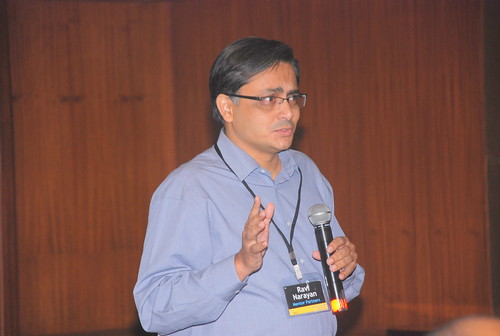
Ravi Narayan
Ravi Narayan of Mentor Partners talks about "The Role of a Mentor in a Startup"

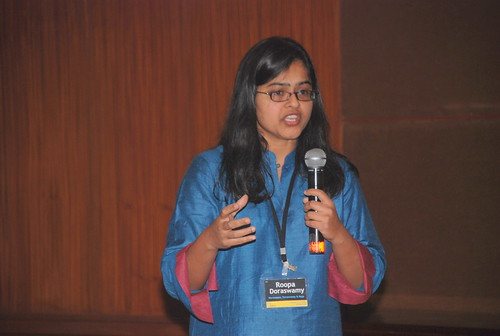
Roopa Doraiswamy
Roopa Doraiswamy on legal issues for startups

Vishal Gondal
Vishal Gondal (Indiagames)

Rajiv Dingra
Rajiv Dingra of WATBlog and WATShow

Alok Kejriwal
Alok Kejriwal (games2win.com)

Bijoy Singhal
Bijoy Singhal (Microsoft)

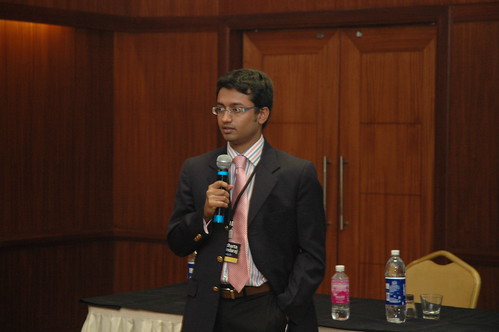
Siddharta Govindaraj
Me :P

Gaurabh Mathure
Gaurabh Mathure on the role of design

Chintan Mehta
Chintan Mehta (Yahoo!)

Sujai Karampuri
Sujai Karampuri of Sloka Telecom (Incidentally, Sloka presented at the very first Proto.in)

Laura Parkin
Laura Parkin (NEN)

Atul Chitnis
Atul Chitnis

Surojit Niyogi
Surojit Niyogi on writing Facebook apps

Mohanjit Jolly
Mohanjit Jolly of DFJ on bootstrapping a startup

Samir Sood
Samir Sood (Google M&A)

Wednesday, January 30, 2008

DEMO live blog and other interesting articles

If you've been following Proto.in, you might know that the initial inspiration came from the DEMO conference in the US. Well, DEMO is going on right now and it's interesting to follow the conference and see how everything happens there. So, if you are interested, check out these links